Is glucose the same as blood sugar? The simple answer (and why the words get mixed up)
Glucose vs. blood sugar in one sentence
Yes, in everyday use they mean the same thing: "blood sugar" is the glucose in your blood. The small difference is that glucose is the sugar molecule itself, the main fuel your cells run on, while blood sugar (or blood glucose) is the amount of that glucose circulating in your bloodstream right now. So when your doctor talks about your glucose level and your meter shows your blood sugar, they are describing the same number, and a steady daily routine, supported by something as simple as Gluco Recover, is about keeping that number in a healthy range.
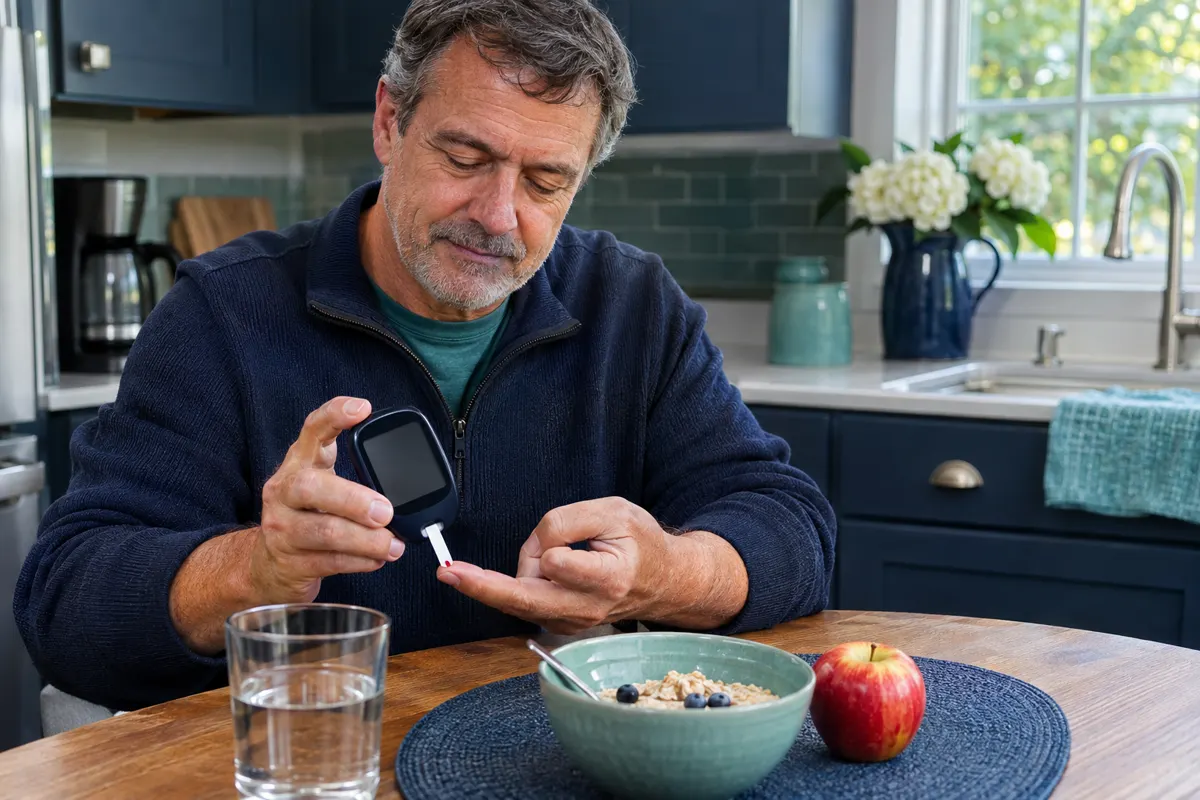
You get a lab report that says "glucose," your meter says "blood sugar," a nurse mentions "blood glucose," and a food label talks about "sugars." No wonder the question is glucose the same as blood sugar? keeps growing in searches. The short version is reassuring: they are two names for one thing. Here is why the words get mixed up, what the units mean, and what to actually do with the number.
Glucose: the fuel
Glucose is a simple sugar, one of the smallest building blocks of carbohydrates. It is the main source of energy for your cells, and your brain relies on it especially heavily. You get glucose from food: starches in bread, rice, pasta and potatoes are long chains of glucose, and many other carbohydrates are broken down into it during digestion. Your liver can also release stored glucose and even make new glucose between meals and overnight.
In other words, glucose is not a bad thing. It is the fuel. The goal is not to get rid of it but to keep the amount in your blood steady, without big spikes after meals or long periods running too high.
Blood sugar: the level of that fuel
Blood sugar is simply how much glucose is in your blood at a given moment. After you eat, glucose from your meal enters the bloodstream and the level rises. Your pancreas releases insulin, a hormone that helps move that glucose into your muscles, liver and fat cells, and the level comes back down. Between meals, another hormone called glucagon tells the liver to release glucose so the level does not drop too low. (Wondering which way insulin pushes your numbers? See does insulin raise or lower blood sugar.)
When people say "my blood sugar is high," they mean the glucose concentration in their blood is above the healthy range. When a doctor orders a "fasting glucose" test, it is a blood sugar test taken after not eating for at least eight hours. Same thing, different vocabulary. If you want the bigger picture of how these hormones work together, our blood sugar terms explained guide covers insulin, glucagon, A1C and more.
Why the words get mixed up
There are three main reasons people are confused by the terms:
- Clinical vs. everyday language. Labs and doctors tend to say "blood glucose" or "plasma glucose" because it is precise. Patient materials, meters and conversation use "blood sugar" because it is easier to say.
- "Sugar" means different things. On a food label, "sugars" includes table sugar (sucrose, which is glucose plus fructose), milk sugar (lactose) and fruit sugar (fructose). Only glucose is what a blood sugar test measures.
- Different places, different units. A reading of "100" in the United States and "5.6" in Canada or the UK describe almost the same level, just in different units.
Glucose, blood sugar and food sugar at a glance
| Term | What it means | Where you see it |
|---|---|---|
| Glucose | The simple sugar molecule your cells use as fuel | Biology, lab reports, CGM apps |
| Blood sugar | The amount of glucose in your blood right now | Home meters, everyday conversation |
| Blood glucose / plasma glucose | The same measurement, clinical wording | Doctor's notes, lab results |
| Fasting glucose | Blood sugar after at least 8 hours without food | Routine checkups |
| A1C | Your average blood sugar over roughly the past 3 months | Lab tests, diabetes screening |
| Sugars (food label) | All sugars in a food, including sucrose, fructose and lactose | Nutrition Facts panel |
mg/dL vs. mmol/L: same number, different units
In the United States, blood sugar is reported in milligrams per deciliter (mg/dL). Many other countries use millimoles per liter (mmol/L). The conversion is simple: divide mg/dL by about 18. So 100 mg/dL is roughly 5.6 mmol/L, and 180 mg/dL is about 10 mmol/L. If you travel, read health information from another country or use an imported meter, check the unit before you compare numbers.
What the number tells you
The CDC uses these fasting blood sugar ranges for screening:
- 99 mg/dL or below: normal
- 100 to 125 mg/dL: prediabetes
- 126 mg/dL or higher: diabetes
A single reading is a snapshot. Food, stress, sleep, illness and activity all move it, which is why doctors also look at the A1C and at repeated tests. Our normal blood sugar levels chart shows the ranges for fasting, after meals and A1C side by side, and the guide on high blood sugar symptoms explains when a number deserves a call to your doctor.
What to do with this knowledge
Knowing that glucose and blood sugar are the same thing makes health information much easier to follow. A few practical takeaways:
- Read lab results with confidence. "Glucose" on a lab sheet is your blood sugar. Ask your doctor whether it was a fasting test.
- Read food labels for the whole picture. Total carbohydrates, added sugars and fiber all influence how much glucose ends up in your blood. Our guide to reading a nutrition label for blood sugar walks you through it.
- Focus on steadiness. Balanced plates, a short walk after meals, good sleep and a consistent daily routine help keep glucose from swinging up and down. A simple daily support such as Gluco Recover fits easily into that routine.
- Track patterns, not single numbers. If you test at home, a simple blood sugar log shows you what really moves your levels.
The one-line version
Glucose is the fuel; blood sugar is how much of that fuel is in your blood. Same number, two names, and steadiness is the goal.
Our recommendation: Gluco Recover

Once you understand that your blood sugar is simply the glucose in your blood, the goal becomes clear: keep it steady, day after day. To support that routine, Gluco Recover is the option we recommend. It was made for exactly this everyday goal: supporting healthy blood sugar balance, steady energy and healthy weight management as part of a healthy lifestyle, with a dose that takes seconds a day. Our full Gluco Recover review covers every detail, and the Puriva Life home page has a quick overview.
- A plant-based botanical blendEpimedium and Eurycoma longifolia (Tongkat Ali) to support vitality and steady energy, wild yam and nettle root to support metabolic balance, plus saw palmetto and sarsaparilla for overall wellbeing.
- Easy liquid dropsA 2 oz / 60 ml bottle; a simple daily dose under the tongue or in water, easy to tie to a fixed moment of your day.
- Made to a high standardProduced in a GMP-certified, FDA-registered US facility and non-habit-forming.
- Zero-risk trialEvery bundle is backed by a 60-day money-back guarantee, plenty of time to see how it fits your routine.
Because a steady routine works best over several months, the multi-bottle bundles offer the best value: 6 bottles at $49 per bottle ($294, free US shipping), 3 bottles at $72 per bottle ($216, free US shipping) or 2 bottles at $89 per bottle ($178 plus shipping). Prices were noted on the official website and can change; the live price is always shown at checkout.
Gluco Recover is a dietary supplement that complements healthy habits; it does not diagnose, treat, cure or prevent any disease, and it does not replace medication or medical care. If you take prescriptions, especially for blood sugar, talk to your doctor before starting.
Get Gluco Recover from the official site →
Official website · from $49 per bottle · 60-day money-back guarantee
Want the full breakdown first?
Read our complete Gluco Recover review: the formula ingredient by ingredient, what to expect week by week, current bundle prices and how the 60-day guarantee works.
Read the Gluco Recover review →A note on this guide
This article is general information, not medical advice. Only a healthcare provider can diagnose diabetes or prediabetes or interpret your personal results. If you have questions about your numbers, talk to your doctor.